


Chapter:
EMPLOYER SERVICES
Subject:
EMPLOYER CLASSIFICATION
Effective Date:
September 19, 1995
Last Updated On:
November 18, 2023
REFERENCE
Workers Compensation Act R.S.P.E.I. 1988, Cap. W‑7.1, Section 61.
Workers Compensation Board Policy, POL-19, Employer Registration.
Workers Compensation Board Policy, POL-45, Audit of Employer Accounts.
DEFINITION
In this policy
“Injury cost experience” means the ratio of weighted claims cost experience to assessable payroll over the five-year experience period examined for purposes of setting assessment rates.
“Standard Industrial Classification (SIC)” means a Statistics Canada framework for collecting, compiling, and disseminating economic statistics for groups of businesses that are engaged in similar activities.
POLICY
General Concepts of Classification
- The workers compensation system provides protection to employers from the financial risks associated with workplace injuries and illnesses.
- The workers compensation system operates on the principle of collective liability for employers. Revenue is pooled from the entire population of assessed employers and is used to pay the present and future costs for workers who incur claims, as well as the administration costs of the compensation system.
- The intent of the system is not to balance each insured employer’s assessment payment exactly to the insured employer’s costs, but rather to group and assess employers by similar industry.
Classification Structure
-
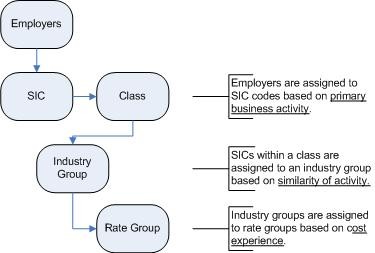
As part of the registration process, as outlined in Workers Compensation Board (WCB) policy, POL-19, “Employer Registration”, employers are required to provide a detailed description of their operations.
The WCB will review the description provided by the employer to identify the employer’s primary business activity.
-
The WCB will compare the primary business activity to the industry description provided for in the Standard Industrial Classification (SIC) framework.
Based on the primary business activity the WCB will assign to that employer a SIC code that best fits the employer’s primary business activity.
- The WCB uses six (6) Classes which reflect the major economic sectors on Prince Edward Island (PEI). The six (6) Classes are:
- Sales and Professional Services
- Agriculture, Fishing & Natural Resources
- Manufacturing
- Construction & Related Services
- Transportation
- Public Sector & Education.
Each SIC code is assigned to a Class according to the primary line of business which the WCB determines to best fit one of the six (6) Classes.
- The SIC codes, within each Class are divided into Industry Groups based on similarity of activity. In making these determinations, the WCB will consider the following:
- Products/services sold.
- Raw materials, equipment, and processes used.
- Occupational mix of workers.
- Customers and competitors.
- Workplace risk of the industry.
- Where there is no clear direction to which Class or Industry Group to which an SIC code should be assigned, the WCB will use its judgement to determine the best fit.
- For purposes of setting assessment rates, Industry Groups are grouped together into Rate Groups.
- The assignment of an Industry Group to a Rate Group within a Class is based solely on the injury cost experience of the Industry Group.
- Rate Groups must have a reasonable level of cost stability to support the implementation of objective rules and statistical tests. The number of Rate Groups established is to ensure a minimum size in order to minimize cost volatility while also spanning the range of cost experience for the majority of industry groups.
Employer Classification Structure Diagram
Assigning SIC Code
- Primary business activity, regardless of the occupation of individual workers, dictates the classification of an employer into an SIC code.
- SIC codes are used to identify the distinct industries operating in PEI. The WCB uses the SIC code and its description of activities as the primary tool to assign employers to an industry.
- Where the SIC code does not provide clear direction to which industry the business operation should be assigned, the WCB will determine the SIC that best represents the primary business activity.
-
Where the WCB determines that an SIC code not previously used best represents the primary business activity, the WCB Board will modify the existing classification structure to include the SIC code.
Temporary Business Activities
-
If an employer undertakes a new business activity which is determined, at the discretion of the WCB, to be temporary; not a regular part of the employer’s existing business activity; and uses all or some of the employer’s workers, this activity may be classified separately from the normal business activity for the period(s) of time that the temporary activity occurs.
Operations In More Than One Jurisdiction
-
If an employer operates business activities partly in PEI and partly outside PEI, the employer will be classified on the basis of the business activity conducted within PEI.
Intermingled Business Activities
- When two or more business activities cannot be classified separately because of the level of personnel intermingling they will be combined, at the discretion of the WCB, into one classification.
-
The highest rated classification will be used if it accounts for at least 40% of the intermingled group of activities.
Management Company
- A management company is a distinct and separate business entity which has effective financial control of one or more associated companies, and has one or more of the following characteristics:
- Sets policy direction for the associated companies.
- Shares a director(s) in common with the associated companies.
- Staff normally only consists of directors and office personnel.
-
Management companies are assigned to the same classification as their associated companies. They are combined with the associated companies for accident cost history and rate setting purposes.
Multiple Business Activities
- The WCB may assign a single employer multiple classifications if the employer is involved in more than one primary business activity and the primary business activity would be separately classified if it were the employer’s only activity.
- The WCB will review each activity to determine if the employer will be assigned multiple classifications. The WCB will consider all relevant considerations including the following factors:
- Whether more than 50% of the revenue is generated from non-affiliated customers.
- The kinds of products or services the business activity produces or provides.
- Whether the product or service is used in the employer’s principal business activity.
- Whether the business activity is a retail store or wholesale outlet and whether that outlet is in a separate location or in a separate area within the manufacturing plant producing the goods.
- Whether less than 50% of the goods being sold are provided by affiliated manufacturing divisions and whether retail activity is incidental to manufacturing.
- Whether the business activity is performed by specific personnel as their sole function.
- Whether each business activity has the same personnel performing functions for each one, but at different times of the year.
Employer Affiliates
- Employers are affiliated, even though they are separately registered, when there is a degree of common control and:
- They are operating businesses that contribute to the production of common goods or services; or
- The businesses share workers or there has been a transfer of workers or assets from one employer to another.
Separately registered employers have a degree of common control when:
- The employers are controlled by members of the same family; or
- One employer controls another employer or both employers are controlled by the same person or group of persons.
For the purpose of this policy, members of the same family may include:
- Spouse, child or stepchild.
- Parent or stepparent.
- Siblings, including half and step siblings, and their children.
- Grandparent or grandchild.
- In-laws.
-
For the purpose of determining whether employers are affiliated, control is defined as the ability or power, actual or potential, direct or indirect through intermediaries, to direct or cause the direction of the management of an employer’s business operations, through the ownership of voting securities, by contract or by other means.
Separately registered employers operate businesses that contribute to the production of common goods or services when one employer is engaged in business activities that are supportive of or incidental to other employer’s primary business activities.
- For the purpose of this policy:
- Supporting employer means an affiliated employer that is engaged in business activities that are supportive of or incidental to another employer’s primary business activities.
-
Primary employer means the affiliated employer that is engaged in those primary business activities.
A supporting employer will be assigned the classification assigned to the primary employer.
When a supporting employer’s business activities are supportive of or incidental to the primary business activities of multiple primary employers, the WCB will determine the supporting employer’s classification in accordance with paragraph 29.
Supportive Business Activity
- Business activities that are supportive of or incidental to an employer’s primary business activity may include, but are not limited to the following:
- Design, including drafting & engineering, research & development related to goods produced/intended to be produced.
- Operation of a plant to produce power/heat for employer’s use.
- Operation of maintenance or repair shops for servicing/repairing employer’s vehicles/equipment.
- Inventory control.
- Manufacture of packaging/packing materials for packing of goods produced by employer.
- Printing or lithography directly onto, or for use on, employer’s goods.
- Warehousing or distribution of employer’s goods.
- Transportation of an employer’s personnel or goods (includes transport carried on before the manufacture of a product).
- Wholesaling of employer’s goods.
- Security of employer’s premises.
- Administration related to employer’s operations (includes office personnel such as administrative support, bookkeeping and financial and human resource services, janitorial operations, and fundraising).
- Warranty repairs carried out by an employer on employer’s goods.
- Marketing, promotion, or communication related to employer’s goods or services.
- Training of personnel relating to employer’s business activities.
- Any operations carried out entirely or partly for the employer’s personnel, including cafeterias, commissaries, parking lots, or medical, recreational, or day care facilities.
- A business activity of an employer that is supportive of or incidental to that employer’s primary business activity is part of that employer’s primary business activity. Therefore, the WCB will not classify business activities of an employer that are supportive of or incidental to that employer’s primary business activity separately or differently from that employer’s primary business activity.
- The following factors will be considered by the WCB in the classification of a business activity supportive of or incidental to more than one classification:
- The predominant business activity.
- The assessable payroll of each business activity.
- The percentage of the total assessable payroll represented by each business activity.
A business activity that supports two or more classified activities will be assessed in proportion to the assessable payroll of each business activity expressed as a percentage of the total assessable payroll for all business activities being supported.
Classification Review
- A review of an employer’s classification may be initiated by the WCB or by the employer.
- The WCB may review the occupations of the employer’s workers as an indication of the type of business activity.
- An employer is responsible for notifying the WCB of any change in their business activity or the addition of a new business activity.
-
If an employer fails to notify the WCB of a change to, or addition of, a business activity, the WCB may reassess the employer retroactively to the date of the change.
An employer’s classification may change as a result of a review when there has been:
- An error in classification.
- An omission/misrepresentation of information supplied by the employer.
- A change in the employer’s operations.
- A change in the WCB classification policy.
The following situations are not considered an error in classification on the part of the WCB:
- Borderline classifications which may be changed on appeal.
- Where information supplied by the employer is incomplete, whether intentional or not.
-
The effective date of the classification for a new employer is always the date on which the business begins operations.
The following table indicates the effective date of classification changes, based on the reason for the reclassification:
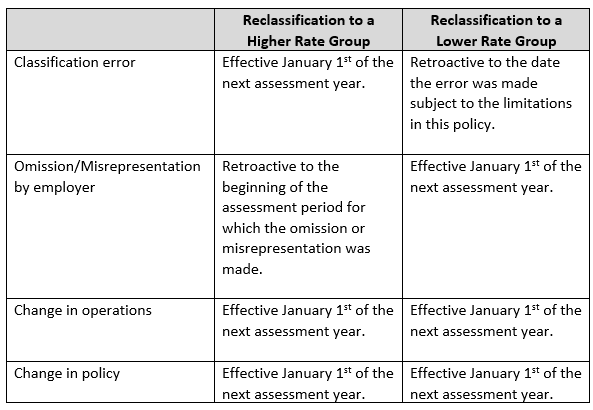
- If an employer’s business activity is reclassified to a lower rate group to correct an error made by the WCB, the reclassification will be retroactively made effective to the date the error was made, subject to the following limitations:
- No retroactive corrections will be made for more than three years from the 1st of January of the year that the error was detected (i.e., the correction will be made for the current year, minus three years, for a total of four years).
- The complete information to allow a proper classification was made available to the WCB, however, an incorrect classification was made.
- Classification changes and related assessment adjustments which result from an audit will be processed as outlined in WCB policy, POL-45, “Audit of Employer Accounts”.
HISTORY
November 18, 2023 – Non-substantive changes for readability and clarity.
August 22, 2013 - Amended to add the criteria used by the Workers Compensation Board to determine whether employers are considered to be affiliated and provide clarity with respect to supportive business activity.
December 16, 2010 – Amended to reflect changes to the Workers Compensation Board classification system. The amended policy was approved on December 16, 2010 with an effective date of January 1, 2011.
January 1, 2008 - The policy was updated as a result of the 60 month policy review process. In addition, the name of the policy was changed from “Industry Classification” to “Employer Classification By Industry”. The Board of Directors approved the changes on November 29, 2007 with an effective date of January 1, 2008.
May 18, 2000 - Replaced “Board” with “Workers Compensation Board” and amended format.
February 4, 1999 - Reviewed and reaffirmed with the Board of Directors.
Board of Directors Approval Date: September 19, 1995