



Chapter:
CLAIMS
Subject:
OCCUPATIONAL DISEASE
Effective Date:
August 23, 2001
Last Updated On:
June 21, 2025
PURPOSE STATEMENT
The purpose of this policy is to describe how the Workers Compensation Board (WCB) determines whether a disease is considered to be compensable as an occupational disease.
REFERENCE
Workers Compensation Act R.S.P.E.I. 1988, Cap. W-7.1, Section(s) 1 (1) (u), 6, 84, 84.1
Workers Compensation Act General Regulations, EC831/94, Section 9.1
Workers Compensation Board Policy, POL-01, Psychological or Psychiatric Condition
Workers Compensation Board Policy, POL-09, Hearing Loss
Workers Compensation Board Policy, POL-12, Survivor Benefits
Workers Compensation Board Policy, POL-61, Pre-existing Conditions
Workers Compensation Board Policy, POL-71, Conditions for Entitlement
Workers Compensation Board Policy, POL-90, Time Frame Limitations for Claims Filing and Invoicing
Workers Compensation Board Policy, POL-91, Repetitive Strain Injuries
Workers Compensation Board Policy, POL-160, Decision Making
DEFINITION
In this policy:
“Fire inspector” means an inspector as defined in the Fire Prevention Act R.S.P.E.I. 1988, Cap. F-11.
“Firefighter” means a full-time, part-time, casual or volunteer member of a fire department or fire brigade.
“Occupational disease” means a disease arising out of and in the course of employment resulting from causes or conditions characteristic of a particular trade or occupation, or particular employment. It does not include an ordinary disease of life.
“Ordinary disease of life” means a disease that can be commonly acquired from a variety of life situations. A disease will not be considered to be an ordinary disease of life if the risk of contracting the disease through the employment can be shown to be greater than the risk associated with ordinary living experience.
POLICY
- An occupational disease is a disease that is caused by the work environment or activities at work. Occupational disease results from exposure to causes or conditions that are linked to a particular trade, occupation or employment. An occupational disease may occur directly following a work-related exposure or it may develop over time after the exposure. The disease may have resulted from an exposure at one workplace or from multiple exposures at various workplaces.
- All Workers Compensation Board (WCB) claims must be filed within the required timeframe from the date of accident. As the date of exposure may be difficult to determine, the date of accident for an occupational disease is set out in WCB policy, POL-90, Time Frame Limitations for Claims Filing and Invoicing.
- The WCB will determine if a claim can be accepted for an occupational disease using the provisions of this policy and WCB policy, POL-71, Conditions for Entitlement.
- If a claim for an occupational disease is accepted, entitlement will be determined under the WCB policies for wage loss benefits and health care benefits. If the occupational disease results in a fatality, the worker’s dependants may be entitled to benefits under WCB policy, POL-12, Survivor Benefits.
- Examples of diseases that may be considered under this policy include, but are not limited to, contact dermatitis, infectious/contagious diseases, pneumoconiosis, silicosis, asbestos-related conditions, scleroderma, lead poisoning, radiation-related diseases, respiratory disease, asthma caused by sensitizing agents or irritants in the workplace and the diseases set out in regulations as linked to employment as a firefighter or fire inspector.
- The following injuries and conditions are not considered to be occupational diseases under this policy. The criteria for entitlement to compensation benefits and services are set out in the associated policies:
- Noise induced hearing loss claims are considered under WCB policy, POL-09, Hearing Loss.
- Repetitive strain injuries claims are considered under WCB policy, POL-91, Repetitive Strain Injuries.
- Claims for acute psychological or psychiatric reactions resulting from the cumulative effect of multiple work-related events are considered under WCB policy, POL-01, Psychological and Psychiatric Condition.
Criteria for Occupational Disease Claims
- For a claim to be accepted as an occupational disease, all of the following criteria must be met:
- The worker had a work-related exposure to causes or conditions that are known to cause the disease, or there is evidence that there is a significantly increased risk of the disease at the worker’s employment.
- The worker has been diagnosed with the disease.
- The work-related exposure is the dominant cause of the disease.
- The factors the WCB considers when making decisions on claims, including occupational disease claims, are set out in WCB policy, POL-160, Decision Making.
Presumptions for Cancer in Firefighters and Fire Inspectors
- Due to the risks associated with firefighting, specific occupational diseases are presumed to be work-related for workers who:
- Were exposed to the hazards of a fire, other than a forest fire or wild fire, in the course of employment as a fire inspector or firefighter, and
- Have been or were employed as a fire inspector or firefighter for a minimum cumulative period of employment prior to the accident date.
-
The specific occupational diseases and prescribed minimum cumulative periods of employment or service under the presumption are as follows:
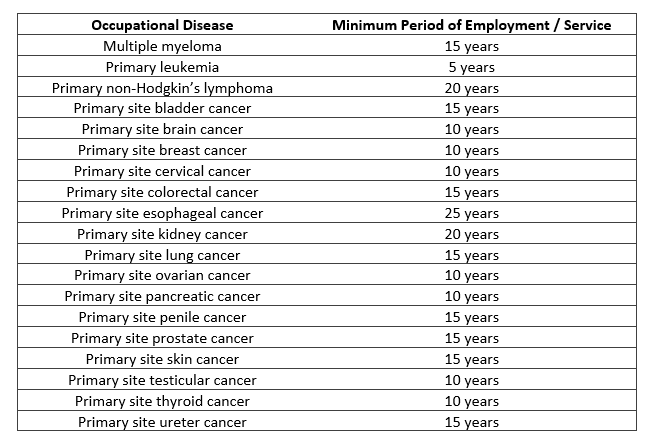
- For the presumption to apply to primary site lung cancer, medical information must support that the worker has been a non-smoker for ten years immediately prior to the accident date.
- The WCB may require documentation, such as service records, to establish exposure and periods of employment.
- The presumption for firefighters and fire inspectors applies to claims for occupational disease with an accident date of January 1, 2019 or later.
- Claims with a date of accident prior to January 1, 2019 and claims for diseases not specified under in the presumptive legislation will be adjudicated like other occupational disease claims, based on the merits of each case.
Determining Causation for Occupational Diseases Not Covered under the Presumptions
- Under the Workers Compensation Act,only those diseases that have been caused by work can be accepted as occupational disease claims.
- Ordinary diseases of life, or those that are caused by natural causes such as age-related degeneration, heredity or genetic factors, and common environmental factors, cannot be considered as an occupational disease under this policy.
- Determining the cause of a disease can be complex. For claims where there is no obviously identifiable work-related cause or condition that has caused the disease, the WCB is required to investigate further. All relevant information, including factors both in and outside of work, will be considered.
-
When determining whether the disease is work-related, the WCB considers the accepted medical and scientific research about the causal association between the exposure and the disease, and the evidence of a work-related exposure.
Medical and Scientific Research
- The WCB may consider the following medical and scientific factors in determining a causal connection between the exposure and the disease:
- Whether the medical and scientific literature shows that the diagnosed disease is characteristic of the trade, occupation, or employment.
- Whether the trade, occupation or employment exposes the worker to a greater risk of this type of disease than the general public.
- The relationship between the reported exposure (duration, frequency, level) and the condition.
- Whether the disease occurred after a reasonable duration of exposure and latency.
- The consistency across the literature on the relationship between the reported exposure and the condition.
- Whether there is an abnormal prevalence of the disease among workers in the same trade, occupation, or employment.
Work-related Exposure
- If a causal connection between the exposure and the disease is established, the WCB will determine whether the exposure was work-related. The factors that may be considered include, but are not limited to:
- The latency, progression, and nature of the worker’s disease.
- Evidence that the exposure, or increased risk, arose out of and in the course of the worker’s employment.
- Descriptions of the work processes, causes and conditions in the worker’s trade, occupation, or employment.
- Degree, nature, timeframe, duration, and frequency of the worker’s exposure.
- The type of personal protective equipment used to determine whether, and to what extent, the worker was protected from exposure.
- The worker’s employment history.
- Whether the worker has any relevant pre-existing conditions, as set out in WCB policy, POL-61, Pre-existing Conditions.
- Other relevant non-work causes such as hobbies, medical conditions, heredity or genetic factors, and industries or employment not covered under the Workers Compensation Act that may have contributed to the disease.
- Where relevant factors outside of work have been identified, there must be sufficient evidence that exposure at work was the dominant cause of the disease to be accepted as an occupational disease claim. This means that the work exposure must be more than a contributing factor. The work exposure must be the dominant cause, that is, the primary or main factor in the development of the disease.
Employment in Other Jurisdictions
-
Where it is determined that an occupational disease was caused by work in more than one Canadian jurisdiction, the claim may be accepted only if employment in Prince Edward Island has contributed to the development of the disease.
The claim will adjudicated through the use of agreements established between the WCB of Prince Edward Island and other jurisdictions.
HISTORY
June 21, 2025 – Non-substantive edits to reflect amendments to Workers Compensation Act General Regulations to add five additional firefighter cancers covered under the presumption.
July 30, 2021 – Non-substantive edits to terminology.
March 29, 2021 – Non-substantive changes to provide clarification and additional information about the criteria and conditions for entitlement to compensation for occupational diseases.
February 12, 2019 – Non-substantive changes to Reference section.
January 15, 2019 – Revised to reflect presumptive legislation for firefighters and fire inspectors, effective January 1, 2019.
September 12, 2016 - Non-substantive changes to reference Workers Compensation Board policy, POL-90, “Time Frame Limitations for Claims Filing and Invoicing.”
January 1, 2014 - Amended to reflect the revisions made to the Workers Compensation Act that became effective January 1, 2014.
July 31, 2008 - Amended to add #6, which clarifies what the WCB considers to be the date of accident for occupational disease.
December 14, 2006 - The policy was updated as a result of the 60 month policy review process.
Board of Directors Approval Date: August 23, 2001