


Chapter:
CLAIMS
Subject:
SUPPORT FOR PERSONAL INDEPENDENCE
Effective Date:
January 24, 2002
Last Updated On:
May 14, 2026
PURPOSE STATEMENT
The purpose of the policy is to explain how the Workers Compensation Board (WCB) supports eligible workers with allowances for personal care, independent living and respite care.
REFERENCE
Workers Compensation Act, R.S.P.E.I. 1988, c W-7.1, Section 18
Workers Compensation Board Policy, POL-92, Health Care Benefits
Workers Compensation Board Policy, POL-172, Allowance and Reimbursement Rate Schedule
DEFINITION
In this policy:
“Impairment” means a medically measurable, permanent
(i) loss of physiological function, anatomical function or anatomical structure, or
(ii) abnormality of psychological function, physiological function, anatomical function or anatomical structure.
“Level of dependence” means an accepted objective measurement of a worker’s functional ability to independently complete activities of daily living and instrumental activities of daily living.
POLICY
- As a result of a workplace injury, a worker may require assistance to maintain a level of personal independence that enables them to remain in their own home.
- If a workplace injury has long-term impacts on a worker’s ability to perform activities related to personal independence, they may be eligible for:
-
Personal Care Allowance (PCA) - to obtain services to assist with Activities of Daily Living (ADLs) and Instrumental Activities of Daily Living (IADLs):
ADLs include self-care, toileting, feeding, bathing, dressing, personal hygiene, ambulation, and transfers.
IADLs include food preparation, housekeeping, shopping, laundry, medication management, financial management, and community activities.
- Independent Living Allowance (ILA) - to obtain services to assist with home maintenance and quality of life, such as snow removal, grass cutting, wood piling, interior house cleaning, maintenance fees, minor home repairs, social and recreational activities, fitness and communications.
- Respite Care Allowance (RCA) - to provide rest periods for a worker’s full time informal caregiver.
-
Eligibility Criteria
-
To be eligible for any of the above-mentioned allowances, all of the following criteria must be met:
-
The worker has a whole person impairment of 10% or greater, based on the 6th edition of the American Medical Association (AMA) Guides to the Evaluation of Permanent Impairment, as a result of the work-related injury.
-
Objective medical information supports the need for support for personal independence as a result of a work-related injury.
-
Specific eligibility criteria for each of the allowances are explained in the following sections.
-
Workers who do not meet the 10% whole person impairment criteria may be considered based on the severity of the injury and objective medical information.
-
For workers who were supported under this policy prior to September 1, 2021, including those who receive a pension or were assessed with an impairment prior to 1995, entitlement to each of the allowances will be determined on a case-by-case basis, depending on the severity of the injury and the worker’s functional abilities.
Personal Care Allowance
-
To be eligible for the PCA, objective medical information must support the need for personal care services.
- A needs assessment may be required to assess:
- The worker’s functional abilities.
- The worker’s immediate and long-term needs.
- The type and extent of service that is required to meet those needs.
Payment of Allowance
-
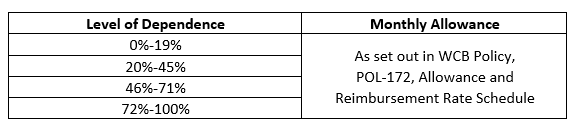
If the WCB determines that a worker requires personal care services, the WCB will provide a monthly allowance based on the worker’s level of dependence.
-
The PCA is payable directly to the worker who is responsible for obtaining personal care services and will continue for as long as the worker meets the eligibility criteria. Receipts are not required.
Independent Living Allowance
ILA Eligibility
-
To be eligible for the ILA, objective medical information must demonstrate physical, psychological or functional limitations that prevent a worker from performing activities associated with independent living.
Payment of Allowance
-
The annual ILA is payable directly to the worker, at the rate set out in WCB Policy, POL-172, Allowance and Reimbursement Rate Schedule, and will continue for as long as they meet the eligibility criteria. The worker is responsible for obtaining services and receipts are not required.
Respite Care Allowance
RCA Eligibility
- To be eligible for the RCA, objective medical information must support the need for constant supervision to remain in the home as a result of the work-related injury. The supervision is normally provided by an informal care giver, such as a family member or friend.
Payment of Allowance
- The annual RCA, at the rate set out in WCB Policy, POL-172, Allowance and Reimbursement Rate Schedule, is payable directly to the worker, who is responsible for obtaining respite services. Receipts are not required.
Costs for Professional Health Care Services
- These allowances do not replace services of professional health care providers, such as a nurse or occupational therapist. WCB will continue to pay for required health care services in accordance with Workers Compensation Board (WCB) policy, POL‐92, Health Care Benefits.
Exceptional Circumstances
-
There may be exceptional circumstances where additional services are required to perform activities related to personal independence and promote quality of life and independent living. The WCB will consider these circumstances on a case-by-case basis, based upon objective medical evidence and a needs-based assessment.
Temporary Allowances
-
If a worker does not have an impairment, but their injury has resulted in a significant temporary need for support, the WCB may approve the allowances on a temporary basis, at the rate set out in WCB Policy, POL-172, Allowance and Reimbursement Rate Schedule.
- Eligibility on a temporary basis is based on the objective medical information, the severity of the injury, and the worker’s physical, psychological or functional limitations.
HISTORY
May 14, 2026 – Non-substantive changes to reflect new policy, Allowance and Reimbursement Rate Schedule (POL-172).
April 3, 2025 – Amended to clarify eligibility for personal care, independent living and respite care allowances and will introduce potential support for workers who do not meet the 10% whole person impairment level but experience significant functional limitations as a result of their work-related injury.
September 1, 2021 - Amended to provide allowances directly to workers for personal care, independent living and respite care, in place of WCB-contracted services and receipted reimbursements. Eligibility criteria defined, pre-approval requirement removed and exceptional circumstances clause added. Previously titled, Support for Independent Living.
January 28, 2016 - The policy was amended to reflect process improvements, including the requirement for pre-authorization of service providers and direct-billing to the Workers Compensation Board.
February 16, 2011 - The policy was updated as a result of the 60 month policy review process. As a result of this review there were a number of changes made in order to provide clarity regarding services provided under this policy.
May 27, 2004 - Amended to reflect that when the Workers Compensation Board authorizes home care services, the services will be procured by using standing offers.
January 24, 2002 - Replaces “Home Care of WCB Claimants”, dated November 15, 1994 and “Child Care Costs” dated November 15, 1994.
Board of Directors Approval Date: January 24, 2002